

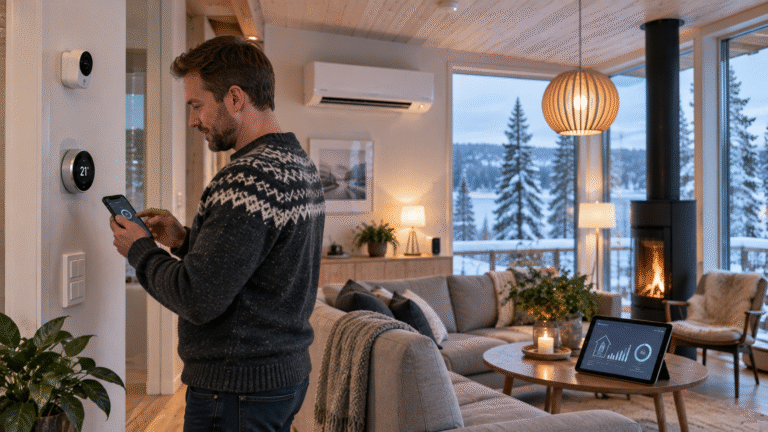
Smart home technology has moved well past the novelty stage in Finland. What started with a handful of enthusiasts installing smart bulbs and voice assistants has grown into a genuine part of how many Finnish households manage heating, security and daily convenience. Given how much of a typical Finnish household budget goes toward heating, and how important reliable security feels during the long, dark winter months, it makes sense that smart home adoption here has leaned heavily toward practical energy and safety applications rather than pure novelty gadgets. This article covers what is actually popular right now, how energy management systems work in practice, what security options exist, how well this technology fits into older housing stock, and what the real costs and payback periods look like.
The most popular smart home solutions in Finland right now
Smart thermostats and heating controllers sit at the top of the list for good reason, given how central heating cost is to the Finnish household budget. These systems allow room by room temperature control, scheduling based on occupancy patterns, and remote adjustment through a phone app, which matters a great deal for anyone who wants to lower the temperature while away and have the house comfortably warm again exactly when they return rather than heating an empty home unnecessarily for hours.
Smart lighting and voice assistant integration remain popular as well, particularly given how much artificial lighting Finnish homes rely on during the darkest months of the year, when scheduling lights to mimic natural daylight patterns can genuinely help with mood and daily rhythm. Video doorbells and connected security cameras have also seen strong adoption, driven partly by a general rise in package deliveries and partly by the reassurance they offer during long periods when a property might sit empty, such as during a summer cottage stay when the main residence is unoccupied for weeks at a time.
See also: How cutting-edge tech is enhancing radiation detection today
Energy management and heating automation
Energy management is where smart home technology delivers its most measurable value in Finnish conditions. Modern systems go well beyond simple scheduled thermostats, using occupancy sensors, weather forecast data and learning algorithms that adapt to a household’s actual patterns over time, gradually reducing unnecessary heating without requiring constant manual adjustment from the homeowner. Some systems integrate directly with electricity spot pricing, automatically shifting flexible loads such as water heating or electric car charging to hours when electricity is cheaper, which has become increasingly relevant as more Finnish households move to spot price electricity contracts rather than fixed rate plans.
Companies focused on Finnish home technology, including Marulla, have highlighted that the combination of heat pumps with smart control systems tends to deliver the biggest measurable savings, since a heat pump already offers strong baseline efficiency and a smart controller optimizes exactly when and how hard it runs based on real time conditions rather than a fixed schedule that cannot adapt to unusually cold or mild days. Motiva, the national energy efficiency organization, has published guidance suggesting that smart heating controls alone can meaningfully reduce annual heating costs in a typical Finnish home when properly configured, without requiring any change to the underlying heating system itself.
Security and remote monitoring
Security applications of smart home technology have grown alongside general adoption, and Finnish households have particular reasons to value remote monitoring given how common it is to own a second property, typically a summer cottage, that sits unoccupied for extended periods. Connected cameras, door and window sensors, and smart locks that can be checked and controlled remotely give owners genuine peace of mind about a property they might not physically visit for weeks or months at a stretch.
For primary residences, integrated systems combining door sensors, motion detection and camera footage that sends alerts directly to a phone have become common enough that many Finnish insurance providers now offer modest premium reductions for homes with verified smart security systems installed, treating it similarly to how a traditional monitored alarm system has long been treated. It is worth noting that any connected security device introduces a genuine cybersecurity consideration, and choosing devices from reputable manufacturers with a track record of security updates matters more here than the flashiest feature list, since a poorly secured camera can become a liability rather than a protection.
Compatibility with older homes
A significant portion of Finland’s housing stock predates modern smart home wiring standards, and this is one of the more common concerns homeowners raise before investing in this kind of upgrade. The good news is that most current smart home technology has been specifically designed around retrofit scenarios rather than assuming new construction wiring, with wireless protocols and battery powered sensors that avoid the need to run new cabling through existing walls in most cases.
Smart thermostats designed for retrofit installation can typically work with existing heating system wiring in older homes with only minor adaptation, though homes with older, non standard heating control wiring occasionally need an electrician’s involvement to confirm compatibility before purchase. Older apartment buildings with shared heating systems present a more specific challenge, since individual smart thermostat control sometimes requires cooperation from the building’s housing association rather than being purely an individual apartment decision, which is worth checking before assuming a straightforward installation.
Costs and payback period
Smart home investment costs vary enormously depending on scope, from a basic smart thermostat costing relatively little to a comprehensive whole home system covering heating, security and lighting that represents a more significant investment. Sitra, the Finnish Innovation Fund, has researched how digital tools including smart home technology fit into Finland’s broader energy transition goals, noting that the households seeing the strongest financial payback tend to be those combining smart controls with an already efficient heating system such as a heat pump, rather than trying to compensate for a fundamentally inefficient heating setup through automation alone.
For a typical smart thermostat and basic energy management setup, payback through reduced heating costs commonly falls within a few years for most Finnish households, making it one of the more financially sensible smart home investments available. Security focused systems are harder to justify on pure financial payback terms, since their value lies more in risk reduction and peace of mind than in direct cost savings, though the modest insurance discounts some providers now offer help offset part of the installation cost for households that value the added security regardless.
Frequently asked questions
Are smart home security systems actually reliable in Finland?
Reputable systems from established manufacturers with regular security updates are generally reliable, though it is worth choosing devices with a solid track record and checking that connectivity remains stable even during winter weather that occasionally disrupts internet service in some areas.
How much does a basic smart home setup typically cost?
A starter setup covering smart heating control for a few rooms can be relatively affordable, while a comprehensive system covering heating, security and lighting across an entire home represents a considerably larger investment, so most households start small and expand over time.
Is professional installation required, or can smart home devices be set up without help?
Many smart home devices are designed for straightforward self installation, though anything involving electrical wiring, such as certain thermostat models or built in heating controls, is worth having checked or installed by a qualified electrician, and Traficom, the Finnish Transport and Communications Agency, provides guidance on connectivity and device requirements that can help households confirm a new system will work reliably within their existing home network.