

I walked into an office last winter and noticed the smell before I noticed anything else. It wasn’t overwhelming. It wasn’t the kind of smell that makes you stop at the door. It was subtle, that slightly stale, slightly warm quality that builds up in enclosed spaces when air isn’t moving properly and surfaces aren’t being cleaned the way they should be. The kind of smell that people who work there stop noticing after the first week.
The receptionist looked tired. Two desks in the open area were empty; the people who sat there were apparently sick, had been for days. A half-eaten sandwich was sitting on a counter near the printer, which I mention only because that printer was the kind of shared touchpoint that thirty people use every single day without thinking about it.
Nobody had connected any of these things. The tiredness, the sick days, the air, the surfaces. They were just running the office the way they always had.
That visit changed how I think about what clean enough actually means in a commercial space.
The Hazards Nobody Talks About Until Someone Gets Sick
Most conversations about office cleanliness stay at the surface level, literally. Visible dust. Stained carpets. Smudged glass. Those things matter, but they’re not where the real health risks live. The genuinely dangerous stuff is the stuff you can’t easily see, and in most commercial offices, it’s present in quantities that would surprise the people working there.
Germs are the obvious starting point. The average office keyboard carries more bacteria per square inch than a toilet seat; that particular statistic gets cited a lot because it’s both accurate and genuinely difficult to process. But keyboards are only one surface. Door handles, elevator buttons, shared phones, mouse devices, communal kitchen taps — all of these cycle through multiple hands every hour of every working day. Without consistent, targeted disinfection, they function as distribution networks for whatever illness is currently making its way through the team.
Mold is less discussed but arguably more serious. It tends to grow in places people don’t regularly look, behind furniture pushed against exterior walls, under kitchen sinks, around window frames, and in ceiling tiles near air conditioning units. Mold exposure doesn’t always produce dramatic symptoms immediately. It shows up as persistent headaches, unexplained fatigue, and respiratory irritation that employees attribute to allergies or stress. By the time someone thinks to look for a source, the colony has often been there for months.
Dust accumulation in commercial spaces operates differently than it does in homes. Offices generate significant quantities of fine particulate matter from paper handling, printer toner, fabric fibers from furniture and carpets, and foot traffic. That particulate settles on horizontal surfaces and in ventilation pathways, and when the HVAC system runs, it gets redistributed into the air that people are breathing for eight hours a day. Over time, this creates a chronic low-level respiratory burden that wears people down without ever producing a single obvious symptom they’d think to report.
Then there are VOCs, volatile organic compounds, which come from office furniture, cleaning products, adhesives, paints, and certain types of flooring. In well-ventilated, regularly cleaned spaces, VOC concentrations stay at manageable levels. In offices where cleaning is infrequent and ventilation is poor, they accumulate. The health effects range from eye and throat irritation to headaches to, in cases of prolonged high-level exposure, more serious neurological effects. Most people working in affected spaces have no idea that what they’re experiencing has a chemical source.
Allergens round out the picture. Pet dander brought in on clothing, pollen tracked in seasonally, and dust mite populations thriving in carpet fibers that haven’t seen a proper extraction clean in years, for employees with sensitivities, these are not minor inconveniences. They’re a daily health tax being paid for working in a space that isn’t being properly maintained.
See also: How Home Automation Simplifies Daily Living
Sick Days Are Not Random: They Have Sources
There’s a tendency in business to treat employee absenteeism as an unpredictable variable. People get sick. It happens. Nothing to be done.
That’s not really accurate.
Research into workplace illness patterns consistently shows that commercial environments with poor sanitation protocols experience meaningfully higher rates of employee sick days than those with structured, professional cleaning routines. Studies out of occupational health institutions in the UK and North America have found that high-touch surface contamination in offices is directly correlated with the spread of common viruses, influenza, norovirus, and rhinovirus through teams. One infected surface, touched by enough people over a single morning, can seed an illness event that costs a company dozens of lost work hours before the week is out.
The financial arithmetic is uncomfortable. A single employee sick day costs a business, on average, somewhere between one and three times that employee’s daily salary once you factor in lost output, the productivity drag on colleagues who pick up the slack, and potential overtime costs to catch up. Multiply that across a team of twenty, across a flu season that runs four months, and you’re looking at a number that makes a professional cleaning contract look very inexpensive by comparison.
What makes this particularly frustrating is that a significant portion of workplace illness transmission is preventable. Not all of it; people bring things in from outside, and no cleaning program eliminates every pathogen. But consistent, proper sanitization of high-touch surfaces, combined with good air quality management, reduces the transmission environment substantially. The illness still enters the building. It just doesn’t spread the same way.
Indoor Air Quality Is the Invisible Problem
If you asked most office managers what their biggest health-related operational concern is, air quality probably wouldn’t make the top five. That’s worth examining, because the evidence suggests it probably should.
The Environmental Protection Agency has documented that indoor air can be two to five times more polluted than outdoor air in urban environments, which is a striking statistic given that people in offices are typically indoors for the majority of their working day. The sources are multiple and cumulative: VOCs from materials and products, particulate matter from activities and occupants, biological contaminants from mold and bacteria, and carbon dioxide buildup in spaces where ventilation systems aren’t maintained.
The cognitive effects of poor indoor air quality are measurable. Studies published in environmental health journals have found that doubling ventilation rates in office environments produces significant improvements in cognitive function scores among workers, memory, processing speed, and decision-making. The reverse is also true. People working in environments with elevated CO₂ and particulate levels score worse on cognitive tasks than they do in cleaner air environments, even when they don’t consciously notice that the air quality is poor.
Regular professional cleaning addresses this directly. Thorough dusting of ventilation surfaces, filter cleaning, carpet extraction that removes deep-seated particulate, and consistent surface sanitation all contribute to a measurably better air environment. This isn’t a soft wellness claim. It’s a documented operational improvement that shows up in how effectively people work.
What Professional Cleaning Actually Eliminates Versus What a Quick Clean Misses
This is where the distinction between surface cleaning and genuine professional maintenance becomes concrete. When an office is cleaned quickly, as most are when cleaning is treated as an afterthought, certain things happen consistently. Visible surfaces get wiped. Floors get vacuumed or mopped. Bins get emptied. The space looks acceptable.
But the high-touch surface rotation doesn’t happen on a proper schedule. The areas behind and beneath furniture don’t get addressed. The kitchen appliances get wiped down but not sanitized. The washroom fixtures are cleaned, but the less obvious contact points, flush handles, tap bases, and paper towel dispenser surfaces are missed. The carpet gets vacuumed but never extracted. The ventilation grilles accumulate dust that the vacuum never reaches.
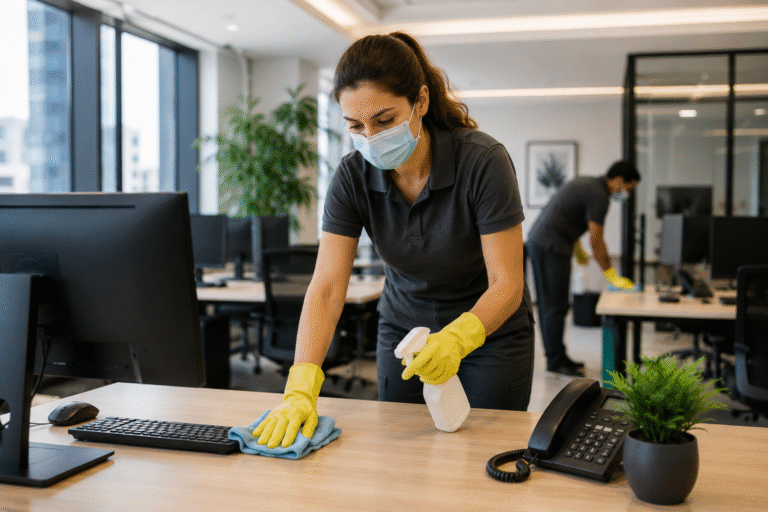
Professional commercial cleaning services operate from protocols specifically designed to catch what routine cleaning misses. High-touch surfaces are identified, mapped, and disinfected on rotation schedules calibrated to how frequently they’re used. Deep cleaning cycles address the accumulation that builds up in the spaces nobody looks at regularly. Equipment, like industrial HEPA vacuums, steam sanitizers, and extraction cleaners, handles the particulate and biological load that consumer-grade tools can’t. Products are selected for genuine disinfection efficacy rather than just surface appearance.
The difference isn’t visible in the way a dirty floor versus a clean floor is visible. But it’s present in the air, in the surface contamination levels, in the mold absence, and in the allergen load, and it shows up over time in how healthy the people working in that space actually are.
Choosing the Right Partner for This Kind of Work
Not every cleaning company delivers this level of service, which means choosing the right one is actually an important decision rather than a commodity purchase.
The things worth looking for are fairly specific. Does the company conduct an onsite visit before proposing a cleaning plan? Any provider willing to quote without seeing the space is guessing, and guessing isn’t a cleaning protocol. Are the products they use genuinely eco-friendly and non-toxic, or are they using chemical disinfectants that solve the bacterial problem while creating a VOC one? Is the staff properly trained and screened, particularly for businesses in environments where confidentiality matters?
Does the company offer a customized plan, one that reflects the actual layout, usage patterns, and needs of your specific space, or a generic package that gets applied to every client regardless of what they actually need?
These questions matter because the health outcomes described in this article don’t come from hiring any cleaning company. They come from hiring one that actually understands commercial environments and takes the work seriously.
That’s exactly what elite cleaning services operating in the GTA market are built to deliver: customized cleaning plans, trained professionals, eco-friendly products, and a consistent schedule that treats your commercial space as a healthy environment, not just a surface to be made to look presentable. If you’ve been operating with the assumption that your current cleaning arrangement is enough, an onsite visit is the fastest way to find out whether that assumption is actually correct.
Most business owners who’ve made that call are surprised by what they learn.