

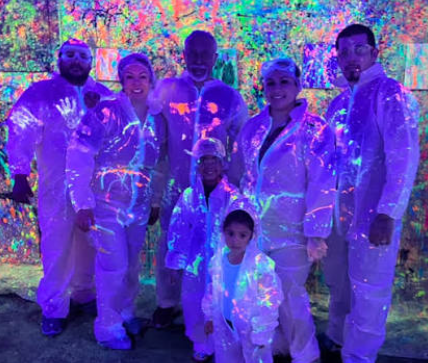
Your team just survived a brutal quarter. Deadlines stacked on top of deadlines, back-to-back meetings, and a Slack inbox that never actually hit zero. So what does management suggest? A catered lunch in the break room. A gift card. Maybe a trivia night that half the team skips.
None of that moves the needle. What your coworkers actually need is something physical, loud, and completely ridiculous, where the only goal is to make a mess and laugh about it. Group paint splatter events check every one of those boxes, and the science behind why they work is surprisingly solid.
The Stress Problem Is Worse Than Most Teams Admit
Before you roll your eyes at “team wellness,” consider what’s actually happening in most American offices. According to the U.S. Occupational Safety and Health Administration, 83% of U.S. workers suffer from work-related stress, and more than half report that stress bleeds directly into their home lives. That’s not a productivity footnote. That’s most of your team, carrying weight that a free lunch won’t fix.
The usual corporate responses, a wellness webinar, a meditation app subscription, a mandatory fun Friday, tend to address the symptom while leaving the pressure cooker sealed. What actually helps is a genuine departure from the setting and mental mode that caused the stress in the first place.
Paint splatter is about as far from a conference room as you can get.
What Makes Paint Splatter Different From Every Other Group Activity
Escape rooms are fun, but they recreate pressure. Bowling alleys get loud and the lanes fill with people checking their phones. A cooking class still has rules, instructions, a right way to do things. Paint splatter has none of that.
Here’s the core distinction: most team activities reward skill. Paint splatter rewards abandon. There’s no wrong canvas. No technique to master. No one is better at it than anyone else. Your CFO and the newest intern stand in the same room in matching ponchos, hurling paint at a canvas, and for an hour, zero hierarchy applies.
That social flattening is genuinely rare. And it’s exactly what makes the activity stick in people’s memories.
The CHAOS Framework: Four Reasons This Actually Works
After watching dozens of teams go through creative physical experiences, a pattern emerges. Call it the CHAOS framework, four things paint splatter delivers that most other outings don’t:
- C — Controlled chaos. You’re making a mess in a space designed for it. No consequences, no cleanup duty. That permission is psychologically freeing.
- H — Hands-on physicality. Your body is involved. You’re flinging, brushing, and splashing. Physical movement interrupts the mental loops that stress creates.
- A — Absence of outcome pressure. Nobody judges the art. The canvas is yours to keep no matter what it looks like.
- O — Open self-expression. Color choices, technique, intensity, all of it reflects something about the person. You learn things about coworkers you’d never get from a PowerPoint.
- S — Shared vulnerability. Everyone looks silly in goggles and a poncho. Shared silliness builds more trust than a ropes course ever will.
“Psychological safety not only enhances individual employee well-being but strengthens the organization by fostering a culture of creativity and effective teamwork.” — Arthur Evans Jr., PhD, CEO of the American Psychological Association, commenting on findings from the 2024 Work in America Survey, which found that 43% of employees report feeling tense or stressed during a typical workday.
The APA finding matters here. Activities that create psychological safety, even outside work hours, carry over. You return to the office with different memories attached to your coworkers’ faces. That changes the dynamic.
A Concrete Scenario: What the Day Actually Looks Like
Picture a marketing team of fourteen people. They’ve just shipped a major campaign and burned through six weeks of 10-hour days. Someone books a splatter session on a Thursday afternoon, 3 PM, off-site. Everyone shows up skeptical.
By the 15-minute mark, the creative director has paint in her hair and doesn’t care. The data analyst, who has never once spoken up in a group setting without a slide deck in front of him, is laughing so hard he can barely stand up. Two coworkers who have been quietly clashing for months end up comparing canvases and genuinely complimenting each other.
That’s not hypothetical magic. That’s what happens when you remove the professional performance layer and let people just be people for an hour.
Comparing Your Options: A Practical Look at Team Outings
| Activity | Skill Barrier | Hierarchy Flattening | Takes-Home Keepsake | Truly Unplugged |
| Paint Splatter | None | High | Yes (canvas) | Yes |
| Escape Room | Low | Medium | No | Yes |
| Bowling | Medium | Low | No | No |
| Cooking Class | Medium-High | Low | Sometimes | No |
| Happy Hour | None | Low | No | No |
The keepsake column matters more than it sounds. Every person walks out holding a canvas they made. That physical artifact sits on someone’s desk or gets hung in their apartment. Every time they see it, they remember that afternoon and the people they shared it with. No other outing on that list does that.
How to Plan One Without Overthinking It
You don’t need an HR committee or a six-week lead time. Here’s a practical checklist:
- Count your headcount and check for group packages. Most venues offer meaningful discounts starting at 10 to 13 people.
- Book a weekday afternoon rather than a Saturday. Midweek sessions feel like a gift, not an obligation.
- Wear clothes you don’t care about, or plan on the venue providing ponchos. Most dedicated splatter rooms supply goggles, gloves, and shoe covers as part of the session.
- Skip the itinerary. The point is no agenda. Tell your team exactly that when you announce it.
- Build in 20 minutes after for everyone to photograph their canvases before heading out.
If you’re in Denver, you can fling paint at All Out Smash, where sessions are designed specifically for group events and each person takes home a glow-in-the-dark canvas they actually painted themselves.
The Part Nobody Budgets For (But Should)
Most companies spend real money on benefits, software tools, and annual reviews, and comparatively nothing on experiences that build actual human connection between coworkers. A splatter session for a team of 15 costs a fraction of what a single day of collective low productivity costs when a team is burned out and going through the motions.
Put the creative chaos on the calendar before someone starts updating their resume. That’s the ROI conversation worth having.
So, what would your team actually remember in six months: the Q3 recap meeting, or the afternoon they covered each other in neon paint?